
Data Collection Drive
Progress, Enhanced Awareness and Challenges
Across several months during the year, a systematic data sensitization drive that involved helping illiterate families to survey existing documents and to check if there are any errors or mistakes in names, DoB or parents’ names etc. village-wise, details of family members enrolled in voter list, those who have Birth Certificate, EPIC card, Aadhar card, etc. was carried out.

Meanwhile, data correction drive started across 10-15 Chakma villages. People attended in large numbers and were sensitized about importance of having error free documents and why it is important to get it corrected. A corollary but important benefit of the data collection drive carried out thus far has been creation and spread of enhanced awareness among the public about the importance of having and maintaining error-free documents.
Important: Completion of the data correction drive will enhance the level of our readiness if NRC is implemented in the state of Arunachal Pradesh. In recent times, several reports have appeared in media about calls for implementation of NRC in several states of Northeast including a prominent Central Government Minister expressing similar views.
The data collection drive is inherently a massive project the absolute success of which will take sustained cooperation and initiative on the part of both village public leaders and general public alike. The importance of the data collection drive however cannot be overstated. The first step to any change initiative being undertaken is to measure the size of the problem. Unfortunately, no current organization has any credible data w.r.t. enrollment of voter list, registration of Birth certificates, Aadhar card, or land holding size, etc. So, the obvious question that arises is – how will we know if we are progressing or not when we don’t even know our current state?
Based on a sample village, where 98 families of 528 persons were surveyed, one-third of eligible people have not even applied for inclusion in voter list. This number will go up if we add those who don’t even know if they have applied or not.
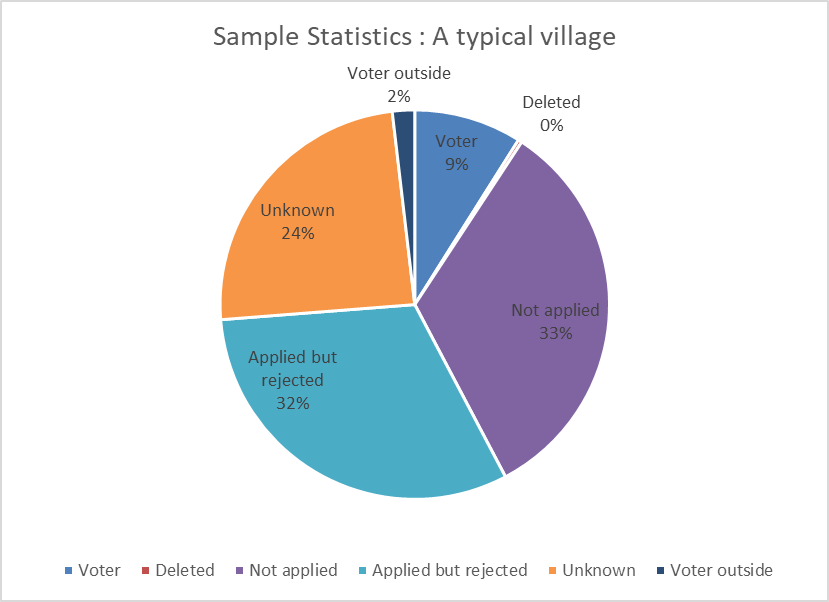
It is sad to see that we have only 9% included as voters. Let’s work together to get the remaining 90% majority included. This is a key focus area for CRDO.
